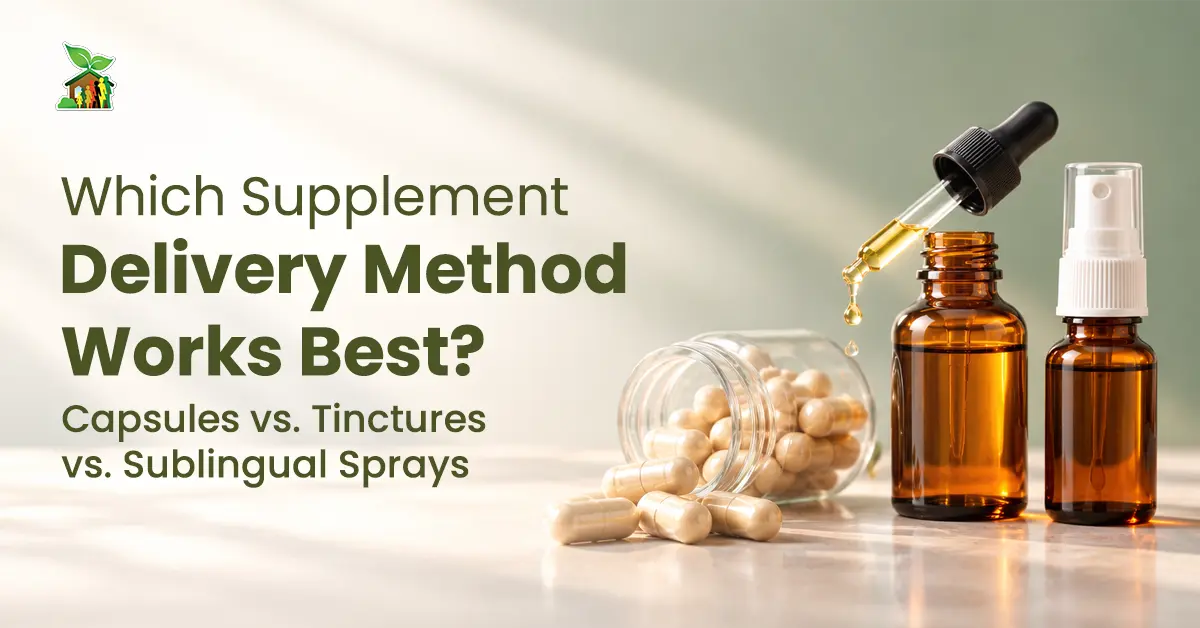
Comparing Capsules, Tinctures, Sublingual Sprays, and Topical Supplements
I’ve been in the natural health world long enough to know that what you take matters, but so does how you take it. I talk to so many people who are spending good money on quality supplements and still not feeling the results they hoped for. A lot of the time, the issue isn’t the supplement itself. It’s the delivery method.
So let’s break this down together. Because understanding supplement delivery methods is one of those things that can completely change how your body responds to what you’re putting in it.
What Are Supplement Delivery Methods, Anyway?
A supplement delivery method is simply the form your supplement comes in and the route it takes to get into your bloodstream. Think of it like sending a package. The contents might be the same, but whether it goes by overnight courier or slow mail makes a big difference in when it arrives and how much of it survives the trip.
The most common types of supplement delivery methods include capsules, tinctures, sublingual sprays, and topicals. Each one enters your body through a different pathway, and that pathway directly affects how much of the active ingredient actually makes it to where it needs to go. This is called bioavailability, which is the percentage of a nutrient your body can actually use.
Let’s go through each one.
Capsules: The Classic, Reliable Workhorse
Most people’s first experience with supplements is a capsule. They’re familiar, easy to dose, and you can take them without tasting a thing. I get it. There’s something reassuring about just swallowing a pill with a glass of water and going on with your day.
Capsules dissolve in your stomach, and the active ingredients get absorbed through your digestive tract. The problem is that digestion is a tough process. Stomach acids, liver metabolism, and digestive enzymes all take their cut before anything reaches your bloodstream.
Research published on NCBI explains this as first-pass metabolism, where compounds pass through the liver after being absorbed from the gut and a significant portion gets broken down before ever reaching circulation.
That’s not to say capsules don’t work. They absolutely do. They offer consistent dosing, a longer shelf life, and are great for traveling. For daily maintenance supplements like magnesium, zinc, or herbs you take consistently over time, capsules are a solid choice.
At Whole Family Products, you’ll find a variety of capsule supplements for different nutritional needs and daily routines.
But capsules aren’t the only option. Depending on the supplement and your preferences, liquid formulations and sublingual sprays may offer different advantages.
Tinctures: Liquid Extracts That Mean Business
Tinctures have been around for centuries, and there’s a good reason herbalists have always loved them. A tincture is made by soaking plant material in alcohol or glycerin to pull out the active compounds into a concentrated liquid form.
When you take a tincture sublingually (by holding it under your tongue for the time specified on the product label), some compounds may be absorbed through the tissues under your tongue and enter the bloodstream directly. This route can help certain ingredients avoid the digestive tract and the liver’s first-pass metabolism. However, the extent of absorption depends on the specific ingredients and formulation, and some of the liquid may be swallowed and processed through the digestive system.
Studies show this makes a meaningful difference. Research from PubMed/NIH confirms that sublingual delivery can achieve high bioavailability precisely by avoiding first-pass liver extraction and enzymatic breakdown in the gastrointestinal tract. And a clinical study published in PMC found that sublingual administration produced the highest peak plasma concentration, the fastest time to peak (around 30 minutes), and the greatest systemic bioavailability compared to oral routes.
Tinctures also offer flexibility in dosing, as the amount can be measured in drops according to the product’s directions. Their shelf life depends on the formulation, with alcohol-based tinctures generally benefiting from alcohol’s preservative properties.

The downside? They have a taste. Some herbs are earthy, strong, or even bitter. But honestly? I see that as part of the experience of connecting with plant medicine. And many tinctures today are available in alcohol-free glycerite formulas if that’s a concern for you.
Sublingual Sprays: Fast, Convenient, and Underrated
This is where I want to spend a moment, because sublingual sprays are something we’re genuinely excited about at Whole Family Products.
A sublingual spray works on the same principle as a tincture. You spray directly under your tongue, and the active ingredients absorb rapidly through the mucous membranes there. What makes sprays special is the convenience and the precision. No dropper to fumble with, no measuring, no mess. Just a quick spray, hold for a moment, and you’re done.
A fascinating study published in PMC compared sublingual glutathione to oral glutathione and found the sublingual form produced significantly better results in terms of actual absorption and antioxidant markers. That kind of direct comparison really illustrates what a difference the delivery route makes. Same compound, dramatically different outcomes.
Sublingual sprays are also a wonderful option for people who struggle with swallowing capsules, or anyone who wants something they can take on the go without water. We see them as one of the best ways to take supplements when you need something fast-acting and highly absorbable. I’m especially excited about our upcoming sublingual spray line, because I believe in getting the most out of every single natural ingredient and sublingual delivery helps do exactly that.
Topicals: Going Through the Skin
Topical delivery (creams, oils, salves) takes a completely different route. Instead of going through the digestive system or under the tongue, active compounds absorb through the skin and into local tissue, or sometimes into the bloodstream over time.
Topicals are ideal when you want targeted support for a specific area like joints, muscles, or skin health. A topical MSM glucosamine cream, for example, may support the area you apply it to in ways an oral supplement can’t quite replicate. Transdermal delivery also bypasses the gut entirely, which is helpful for people with sensitive digestion.
At Whole Family Products, our transdermal creams are formulated with exactly this in mind, getting supportive nutrients where they’re needed most through a route the body can absorb well.
So Which One Is the Best Way to Take Supplements?
Here’s the honest answer: it depends on what you’re taking and what you need it to do.
If I had to map it out simply:
- Capsules are best for daily maintenance, convenience, and consistency.
- Tinctures are best when you want faster absorption, flexible dosing, and the full benefit of plant-based compounds. They are also great for detoxing or of course if you can’t swallow pills.
- Sublingual sprays are best for fast-acting support, maximum bioavailability, and ease of use on the go.
- Topicals are best for targeted, localized support or when gut absorption is a concern. Also, great for those who cannot swallow pills or have an aversion to the taste of tinctures.
Many people, myself included, use a mix of all of these depending on what their body needs on a given day. That’s not overcomplicating it. That’s being intentional.
FAQs About Supplement Delivery Methods
1. Do tinctures really absorb better than capsules?
Studies consistently show that sublingual absorption bypasses first-pass liver metabolism, which means more of the active compound reaches your bloodstream. Research from NIH’s NCBI confirms that the route of administration significantly affects both the rate and extent of bioavailability. So yes, when taken correctly (held under the tongue), tinctures and sublingual sprays tend to be more bioavailable than capsules.
2. What if I have a sensitive stomach?
This is actually one of the biggest arguments for sublingual delivery methods. When something absorbs under your tongue, it never touches your stomach at all. Sublingual sprays and tinctures are often easier for people with sensitive digestion or gut issues.
3. Can I use more than one delivery method at a time?
Absolutely. Many people take capsules for their daily foundational supplements and use tinctures or sublingual sprays when they need something more immediate. It’s not either/or. It’s about choosing the right tool for what your body needs.
4. Are sublingual sprays just as effective as tinctures?
They work on the same mechanism, absorption through the sublingual mucosa, so yes, when formulated well, they can be equally effective. Sprays often have an advantage in convenience and consistent dosing.
5. How long should I hold a tincture or spray under my tongue?
Most research and practical guidance suggests 30 to 60 seconds. This gives the mucous membranes enough time to absorb a meaningful amount before you swallow.
The Bottom Line
The supplement world has come a long way from the one-size-fits-all pill bottle. Today, there are several supplement delivery methods to choose from, and the right option depends on the ingredients, your preferences, and your daily routine. Capsules, tinctures, topical creams, and sublingual sprays each have their own characteristics, making it worth understanding how they differ before deciding which option suits your needs.
We’re always looking for ways to expand our range of supplement options, and I’m excited to share that our sublingual spray line will be available soon.
In the meantime, explore our current offerings in the shop, including our herbal tinctures, and stay tuned for what’s coming next. If you take medication or have concerns about possible interactions with supplements, consult a qualified healthcare professional before adding something new to your routine.