Herbal Tinctures: What You Should Know About Their Benefits and Uses
Herbal tinctures have been around for centuries, but a lot of people still aren’t sure what they are or whether they’re worth trying. I want to clear that up.
If you ever get a chance, look up a documentary called Numen: The Nature of Plants. It follows herbalists, doctors, and researchers who all come back to the same conversation about plant medicine and how much of this knowledge has quietly slipped away from everyday life. It’s one of those things you watch and think, why didn’t anyone teach us this? That’s kind of how I feel about tinctures too.
What struck me most watching it was how the people who work closely with plants, the ones who have studied them for decades, all talk about preparation and delivery like it’s just as important as the plant itself.
You can have the right herb and still not get much out of it if it’s not prepared in a way your body can actually absorb. That’s exactly what makes herbal tinctures so worth understanding. The herbal tinctures benefits aren’t just about which herb you choose. They’re about how that herb gets into your body.
So let me walk you through what they are, how they work, and why I think more families should have them in their homes.
What Are Herbal Tinctures?
Herbal tinctures are concentrated liquid extracts made by soaking plant material, whether that’s roots, leaves, bark, or flowers, in alcohol or glycerin. That soaking process draws out the active compounds from the plant and holds them in a potent, highly absorbable form. What you end up with is a small bottle that packs a real punch. And the herbal tinctures benefits start right there, with that extraction process and how efficiently it sets the herb up for your body to use.
When most people hear “liquid herbal supplement,” they picture something old-fashioned or complicated. But herbal tinctures have been used for thousands of years across cultures all over the world. Research from the NIH’s National Library of Medicine notes that plant extracts including tinctures have long served as the backbone of human wellness traditions globally. This isn’t fringe thinking. This is how people cared for their families long before synthetic options existed, and it’s knowledge we shouldn’t lose.
How Tinctures Work: The Science Behind the Dropper
This is the part I really want you to understand, because it’s what separates herbal tinctures from most other supplement forms, and it’s the core reason the herbal tinctures benefits are as strong as they are.
When you swallow a capsule, it has to dissolve in your stomach, travel through your digestive tract, and then pass through your liver before anything gets into your bloodstream. That journey is called first-pass metabolism, and along the way, a significant portion of the active compounds gets broken down and lost.
Research from NCBI confirms that this liver processing can substantially reduce how much of a supplement your body actually ends up using.
Herbal tinctures work completely differently. When you place drops under your tongue and hold them there for 30 to 60 seconds, the active plant compounds absorb directly through the blood vessels right under your tongue and pass straight into your bloodstream. No digestive detour. No liver filtering them before they have a chance to work.
Research published on PubMed confirms that this sublingual delivery method achieves high bioavailability precisely by avoiding first-pass liver extraction and the enzymatic breakdown that happens in the gut. A clinical study in PMC found that sublingual administration produced the highest peak plasma concentration, the fastest time to peak at around 30 minutes, and the greatest overall bioavailability compared to oral routes.
That’s how tinctures work. And that’s why, when people switch from capsules to a good tincture, they often feel a real difference.
Herbal Tinctures Benefits: What the Research Shows
Let me walk you through some of the most well-studied herbal tinctures used, because the science here is genuinely encouraging.
Immune Support With Echinacea
Echinacea is probably the most researched herb in tincture form. A study on PubMed specifically comparing echinacea extract types found that 50% ethanol tinctures produced the most immune cell stimulation out of all the preparations tested.
Research from PMC/NIH also found echinacea showed consistent immunomodulatory properties, including effects on macrophage activation and natural killer cell activity. Studies show echinacea tinctures may help support the body’s natural defenses, particularly when seasonal challenges hit.
Interestingly, a PubMed pharmacokinetic study comparing echinacea in tincture form versus tablets found that the tincture reached peak absorption in about 30 minutes, while tablets took 45 minutes and showed significantly lower concentrations. Same herb, different delivery, noticeably different results.
Sleep and Relaxation With Valerian Root
If you’ve ever come to me with sleep trouble, valerian has probably come up in that conversation. A meta-analysis published on PubMed reviewed 16 randomized, placebo-controlled trials covering over 1,000 patients and found that valerian may support better sleep quality without producing significant side effects. A larger review of 60 studies from PMC confirmed these findings and noted that valerian may also help with the anxiety component that often drives sleep disruption.
Valerian tinctures are wonderful because they work faster than capsules. When you need rest, that speed really matters.
Inflammation and General Wellness
Research from PMC/NIH highlights that herbal practitioners have long used turmeric tinctures for their potential support of healthy inflammatory response. Traditional herbalists have also long understood that combining herbs thoughtfully, the way a good tincture blend can do, may allow plant compounds to work together in ways that support the body more fully than a single isolated extract.
Tincture vs Capsules: An Honest Comparison
I want to be straightforward with you here, because I think you deserve honesty more than a sales pitch. And part of being honest means saying that the herbal tinctures’ benefits I’ve seen in practice go beyond what a lot of people expect.
Both tinctures and capsules have their place. Capsules are convenient, tasteless, travel-friendly, and great for daily foundational supplements you take consistently over time. I still carry capsule-based products at Whole Family Products and always will.
But in a tincture vs capsules comparison for getting the most out of your herbs? Tinctures come out ahead for three reasons.
First, absorption. The sublingual route bypasses so much of what slows capsules down.
Second, speed. Tinctures typically work within 15 to 30 minutes, while capsules can take 45 minutes to two hours.
Third, flexibility. You can adjust a tincture dose drop by drop. You simply can’t do that with a pre-measured capsule.
Sublingual sprays offer these same benefits in an even more convenient format. No dropper, no measuring, just a quick spray under the tongue and you’re done. A study from PMC comparing sublingual versus oral delivery of the same compound found the sublingual form produced significantly better absorption results and stronger measurable outcomes. Same compound. Dramatically different results based purely on how it was delivered.
This is exactly why we introduced our own line of herbal tinctures. I’ve been thinking about this for a long time, and I’m excited to finally make these options available to you. If you haven’t explored our tinctures yet, now is a great time to see what we have to offer.
Herbal Tinctures Uses: What People Use Them For
People reach for herbal tinctures for all kinds of reasons, and the herbal tinctures benefits vary depending on which herb you’re using and what your body needs. The most common herbal tinctures uses I hear about include supporting the immune system during cold and flu season, promoting deeper and more restful sleep, helping the body handle everyday stress more gracefully, supporting digestion and gut comfort, and providing gentle support for joints and inflammation.
What makes tinctures so flexible is that dropper. You can go higher or lower based on what your body needs that day. Tinctures also tend to have a longer shelf life than many capsule supplements, because the alcohol used in the extraction process acts as a natural preservative.
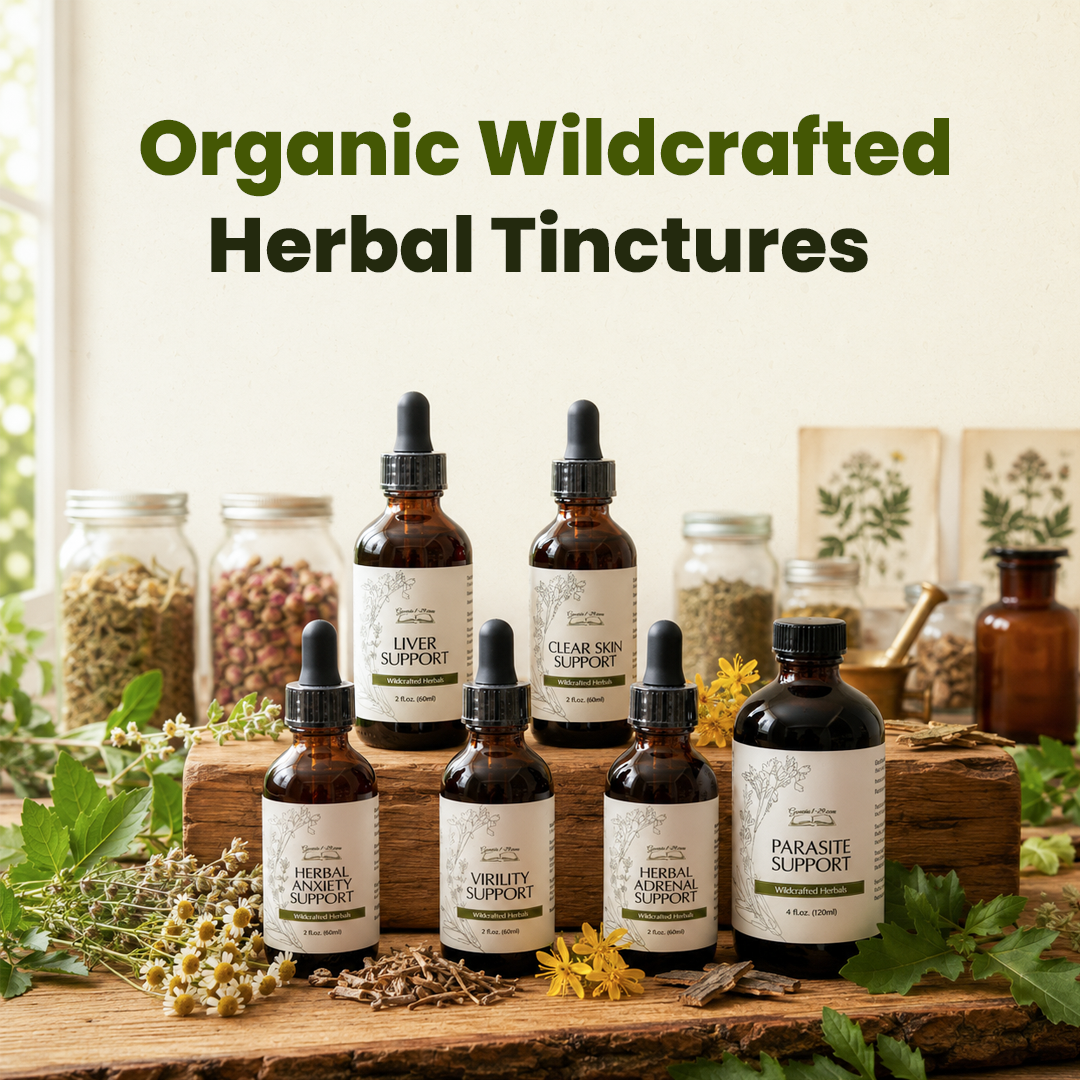
Our herbal tincture line includes options for different areas of interest, from Clear Skin Support and Adrenal Support to Anxiety Support, Liver Support, Virility Support, and Parasite Support. Each formula has its own blend of herbs, making it worth exploring the ingredients and intended use of each product to find one that fits your needs.
FAQs About Herbal Tinctures
1. Are herbal tinctures safe?
When you’re working with quality products made from trusted herbs, herbal tinctures have a strong safety record. The large valerian meta-analysis reviewed subjects from age 7 to 80 and found no severe adverse events. As with anything, quality of the product matters enormously. Choose companies you trust and always read your labels.
2. Do herbal tinctures really absorb better than capsules?
Yes, when taken sublingually. This is one of the most important herbal tinctures benefits to understand. The network of blood vessels under your tongue allows active compounds to pass directly into circulation, bypassing the digestive system. The research on sublingual bioavailability is well-established, including published work from NCBI confirming that the route of administration significantly affects how much of a compound your body ultimately uses.
3. How do I take a tincture?
Use the dropper to place the recommended amount under your tongue. Hold it there for 30 to 60 seconds, then swallow. That’s it. Some people add tinctures to a small amount of water if the taste is strong, though that does reduce the speed of absorption since it then has to pass through digestion.
4. What if I don’t like the taste?
Tinctures do have flavor, sometimes earthy, sometimes bitter, sometimes quite pleasant depending on the herb. Many are now available in alcohol-free glycerite versions, which tend to be gentler and milder in taste. Sublingual sprays are also a great alternative if you want the same fast absorption in a more palatable format.
5. Can I take more than one herbal tincture at a time?
Many people do, and traditional herbalism actually encourages thoughtful combining of herbs for greater effect. Just be intentional about what you’re taking and why. Before adding a new herb to your routine, check whether it could interact with your current medications or supplements.
Final Thoughts
I started Whole Family Products because I believe deeply that God has provided everything we need for our wellbeing right here in the natural world. Genesis 1:29 has always been my guide. Plants have been given to us as food and as medicine, and when we learn to use them wisely, the results can be remarkable.
Herbal tinctures represent some of the best of what plant medicine has to offer. They’re rooted in thousands of years of tradition, supported by modern research, and formulated to give your body the best possible chance of actually absorbing and using what you’re giving it.
If you want to explore what we have available right now, head over to our shop at wholefamilyproducts.com/shop. And if you have any concerns about how a particular herb might interact with something you’re currently taking, please reach out to your holistic provider.