Table of Contents
- 1 PCOS Subtypes: How It Impacts Fertility and What You Can Do
- 1.1 What are PCOS subtypes, and how are they different?
- 1.2 How do doctors diagnose PCOS subtypes?
- 1.3 How are PCOS subtypes classified by symptoms or hormones?
- 1.4 Can PCOS change over time or shift between subtypes?
- 1.5 Are certain PCOS subtypes more common than others?
- 1.6 How do different PCOS subtypes affect ovulation?
- 1.7 Does having a specific PCOS subtype mean worse fertility outcomes?
- 1.8 Can identifying a PCOS subtype improve fertility care?
- 1.9 Supportive Options to Consider Across PCOS Subtypes
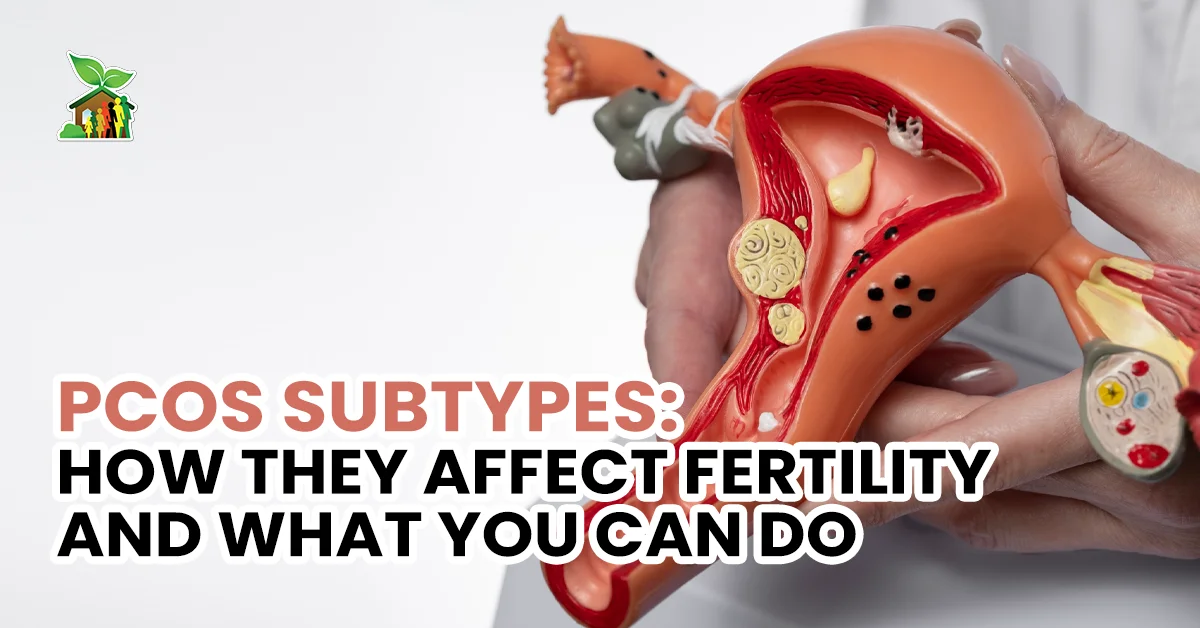
PCOS Subtypes: How It Impacts Fertility and What You Can Do
Many women with PCOS notice early on that their symptoms don’t follow a single pattern.
One woman may deal mostly with irregular cycles. Another may ovulate inconsistently. Someone else may be focused on fertility concerns. Even though the diagnosis is the same, the experience often isn’t.
This difference is one reason researchers now talk about PCOS subtypes. PCOS does not affect everyone in the same way. There are different PCOS subtypes, influenced by hormones, metabolism, and inflammation.
The National Institutes of Health explains that PCOS involves a range of hormonal and ovulatory differences rather than a single presentation.
Looking at PCOS subtypes can help explain why cycles may be irregular, why ovulation can feel unpredictable, or why fertility questions come up. It also provides a clearer way to think about what areas of support may be more relevant, instead of assuming every symptom has the same cause.
What are PCOS subtypes, and how are they different?
PCOS subtypes describe common patterns researchers see in people with PCOS. These patterns are based on hormone levels, metabolic markers, and symptoms, rather than a single test result. This way of looking at PCOS has been especially useful when examining fertility and PCOS, since reproductive experiences vary widely depending on what is driving the condition.
Scientific literature published through the National Center for Biotechnology Information outlines several PCOS phenotypes, including androgen-related, metabolic, inflammatory, and ovulatory
Some people mainly deal with elevated androgens. Others notice blood sugar or insulin challenges. Some experience ongoing inflammation or hormone shifts after long-term birth control use. Many people fall into more than one category, which is why PCOS subtypes often overlap.
How do doctors diagnose PCOS subtypes?
To identify which of the PCOS subtypes you might have, your doctor needs to look for three specific pillars of diagnosis, often referred to as the Rotterdam criteria. You typically need to meet at least two of these three criteria to be diagnosed with PCOS, and the specific combination determines your subtype.
The three pillars are:
- Hyperandrogenism (HA)
This refers to high levels of “male” hormones like testosterone. Your doctor can assess this clinically (by looking for signs like hirsutism, excess facial or body hair or severe acne) or biochemically (by testing your blood for elevated total or free testosterone). According to international evidence-based guidelines, blood tests should use high-quality assays for accuracy. - Ovulatory Dysfunction (OD)
This is usually identified by your menstrual history. If your cycles are longer than 35 days, or if you have fewer than 8 periods a year, it is a strong sign of ovulation problems. However, even regular cycles can sometimes be anovulatory. - Polycystic Ovarian Morphology (PCOM)
This is determined via a transvaginal ultrasound. The current guideline threshold is seeing 20 or more follicles per ovary or having an increased ovarian volume (greater than 10ml). It is not just about having “cysts,” but about the number of developing follicles.
How are PCOS subtypes classified by symptoms or hormones?
Beyond the clinical A, B, C, and D phenotypes, researchers have also begun classifying PCOS subtypes by looking deeper into the hormonal and metabolic drivers. A fascinating study published in PLOS Medicine by Dapas et al. (2020) used genetic and biochemical data to find two very distinct clusters of women with PCOS: a “reproductive” subtype and a “metabolic” subtype.
The Reproductive Subtype appears to be driven more by signaling from the pituitary gland. These women tend to have higher levels of Luteinizing Hormone (LH) and Sex Hormone Binding Globulin (SHBG). Interestingly, women in this group often have a lower Body Mass Index (BMI) and lower insulin levels compared to the other group. Their primary struggle is often related to the ovaries and ovulation.
The Metabolic Subtype, on the other hand, is characterized by a higher BMI, higher blood glucose, and significantly higher insulin levels. In this group, LH and SHBG levels are often lower. For women in this category, PCOS and ovulation are closely tied to metabolic health and insulin resistance, which is why blood sugar stability becomes a central focus.
Can PCOS change over time or shift between subtypes?
Yes. Research suggests that PCOS subtypes are not fixed. Hormones are responsive, and they change based on what’s happening in the body over time. Factors such as ongoing stress, nutrition, sleep quality, physical activity, and metabolic health all influence hormone signaling.
When these factors shift, the way PCOS shows up can shift as well. Some women notice changes in cycle regularity. Others see differences in ovulation patterns or hormone-related symptoms. This doesn’t mean PCOS disappears or suddenly becomes something else, it means the body is responding to its current environment.
This is why it can be helpful to revisit patterns instead of assuming symptoms will always stay the same. Paying attention to how your body responds over time allows for more informed choices and more realistic expectations when supporting hormone balance.
Are certain PCOS subtypes more common than others?
From what I see in the research, yes, some PCOS subtypes show up more often than others. Insulin-related and androgen-related patterns are consistently among the most commonly observed.
One reason this matters is because insulin signaling plays a direct role in how the ovaries produce hormones. When insulin signaling is off, the ovaries may produce higher levels of androgens, which can interfere with ovulation and cycle regularity.
Research published through the NCBI has repeatedly shown a strong link between insulin resistance and PCOS, even in women who do not appear insulin-resistant on the surface
I think this helps explain why cycle irregularity and ovulation challenges are so common in these PCOS subtypes. Studies also show that disrupted insulin signaling can affect communication between the brain and the ovaries, which plays a role in ovulatory function
When ovulation is inconsistent, fertility can be affected. This is where the PCOS fertility impact often comes into the conversation, not as a prediction, but as a reflection of how closely metabolic health and reproductive hormones are connected.
In my view, the reason insulin and androgen-related PCOS subtypes come up so often is that they sit at the center of many of the hormonal feedback loops involved in PCOS. Understanding this doesn’t mean focusing on one issue forever, but it does help explain why metabolic and hormone balance are often considered first when looking at overall PCOS patterns.
How do different PCOS subtypes affect ovulation?
When it comes to PCOS and ovulation, this is one of the areas where subtypes really matter. In Phenotypes A, B, and D, ovulatory dysfunction is a defining feature.
Ovulation may happen infrequently or not at all. When ovulation doesn’t occur, pregnancy cannot happen naturally, and the body also misses the normal progesterone rise that follows ovulation.
From what the research shows, that lack of progesterone can affect cycle stability and uterine support over time. This is why hormone balance is often a focus in these PCOS subtypes.
Some women choose to support this area with a transdermal progesterone option like Fertile Balance Progesterone Cream, especially when cycles are irregular or ovulation is inconsistent. It’s not about forcing ovulation, but about supporting the hormonal environment that normally follows it.
Phenotype C looks different. These women do ovulate and usually have regular menstrual cycles, but they still have elevated androgens and polycystic ovaries. This can be misleading. Having a monthly period can give the impression that everything is functioning normally, yet symptoms such as acne, hair thinning, or excess hair growth may still be present.
In these cases, the focus often shifts away from ovulation itself and toward hormone balance, particularly estrogen metabolism. This is where ingredients like diindolylmethane are frequently discussed in the research. Products such as DIM 150 are commonly used by women who are paying closer attention to estrogen and androgen balance rather than ovulation frequency.
It’s also worth noting that even women with very regular cycles, such as a consistent 28-day cycle, may not be ovulating every month. Regular bleeding does not always equal ovulation. For this reason, clinical guidelines often recommend checking a mid-luteal progesterone level to confirm whether ovulation is actually occurring, regardless of which PCOS subtype someone may identify with.
Does having a specific PCOS subtype mean worse fertility outcomes?
The idea that certain PCOS subtypes automatically lead to poor fertility outcomes simply isn’t supported by the research. PCOS is actually one of the more manageable contributors to fertility challenges, especially when the underlying pattern is identified early.
That said, some subtypes do come with more initial hurdles. Phenotypes A and B, which are the classic anovulatory patterns, tend to require more support at the start than Phenotype C, where ovulation is already occurring. This doesn’t mean pregnancy is unlikely. It usually means the body needs help releasing an egg more consistently.
Where I see fertility delayed most often is in women with a metabolic PCOS subtype, which frequently overlaps with Phenotype A. Insulin resistance doesn’t just affect blood sugar. It influences ovarian hormone production and egg development.
Research shows that when insulin signaling is disrupted, it can compound fertility challenges over time. This is why metabolic support is often a priority. From that perspective, Berberine Complex makes sense as part of a metabolic-focused approach, especially when insulin resistance appears to be a major driver.
Androgen-related patterns can affect fertility differently. Elevated androgens often point back to how estrogen is being metabolized. When estrogen pathways are not balanced, ovulation signaling can become inconsistent, even if insulin levels appear normal. This is where estrogen metabolism deserves attention. Chrysin Plus DIM is commonly used in this context, particularly by women who are focusing on supporting estrogen processing as part of managing androgen-related PCOS patterns.
Can identifying a PCOS subtype improve fertility care?
Absolutely. Knowing your specific subtype allows for precision in your care plan.
If you fall into the “metabolic” cluster or Phenotypes A/B where insulin resistance is a major driver, your fertility support might focus heavily on metabolic health first.
This could involve using tools like insulin-sensitizing approaches or targeted dietary changes to help restore ovulation naturally before moving to stronger interventions. This targeted strategy addresses the root cause of the PCOS fertility impact for your specific physiology.
On the other hand, if you have a “reproductive” subtype with high LH levels but normal insulin, simply focusing on insulin resistance might not be as effective. Your care might need to focus more directly on ovulation induction support using specific protocols.
Supportive Options to Consider Across PCOS Subtypes
No matter which of the PCOS subtypes you align with, supportive care can make a difference. Many women find that targeted supplementation helps bridge the gap in their nutrition and hormonal balance.
If you’re exploring natural ways to support hormone balance and fertility awareness, Whole Family Products offers options that work alongside the body’s natural processes. Products like Fertile Balance can be a helpful addition for general reproductive support, while Chrysin Plus DIM and DIM 150 are often utilized by those looking to support estrogen metabolism. For those focused on metabolic health, Berberine Complex is a popular choice for supporting healthy glucose levels.
Please note: Always consult your healthcare provider before starting new supplements, especially if you are pregnant, nursing, trying to conceive, or taking other medications.